
SAT Grammar Rules, Cheat Sheet and Practice Questions
SAT Grammar is simpler than you think. Learn the rules and practice applying them to improve your SAT Reading and Writing score.
If you keep getting SAT grammar questions wrong, stop deciding which answer sounds better. Learn the rule behind the question. The same sentence structures come back with different names, longer descriptions, and a different subject matter. Once you can see the structure, those details stop getting in your way.
I have spent thousands of hours teaching these rules, helping students reach high scores, and analyzing every available College Board question in detail. The method I teach is straightforward: identify what the choices are changing, find the relevant part of the sentence, and apply the rule. You should be able to explain exactly why your answer works.
Use the rules below, try the practice questions, and keep the grammar-only PDF beside you while reviewing mistakes. The SAT syllabus puts grammar in Standard English Conventions. That is the part of Reading and Writing covered here.
Book Your Free SAT Trial Class
Start your journey to a 1500+ SAT Score.
Which SAT grammar rules do you need to learn?
Start with verbs and sentence boundaries. Students lose marks because they mistake a nearby noun for the subject, treat a participle as a complete verb, or put a comma between two complete sentences. The revision guide below covers Form, Structure, and Sense, followed by Boundaries. Work through both before attempting mixed practice.
How should you use this SAT grammar cheat sheet?
Read the answer choices before rereading the passage. They tell you where to look. Changes to is, are, has, and have point you toward the subject and verb. Changes to punctuation point you toward clauses or an inserted description. Long choices with different opening subjects point you toward modifier placement.
- Identify the difference between the choices.
- Find the subject, finite verb, or clause boundary that decides the question.
- Apply the rule and eliminate each choice that breaks it.
- Read the completed sentence once to confirm your answer.
Keep your review specific. Write “I matched the verb to the noun inside the description” instead of “careless mistake.” Your next practice set should test that same structure until you recognize it reliably.
What is on the SAT grammar cheat sheet?
IC = independent clause. DC = dependent clause. NE = non-essential element. Keep these formulas beside you while reviewing questions.
| What is tested? | Rule or formula |
|---|---|
| Independent clauses | IC ; IC / IC . IC / IC , FANBOYS IC |
| Dependent clauses | DC , IC / IC , DC |
| Non-essential elements | , NE , / — NE — / ( NE ) |
| Essential elements | No punctuation. “That…” creates an essential clause. |
| Simple lists | x , y , and z |
| Complex lists | a , x ; b , y ; and c , z |
| Colons | IC : … / Setup : Payoff |
| Possessives | A’s B → B has to be a noun. |
| Titles and names | Keep the title and name together. |
| Verb questions | Classify: agreement, finite/non-finite, or tense. |
| Pronouns | Match it / its or their / them / they to the antecedent. |
| Modifiers | Read the modifier, then the subject of each choice. |
Learn SAT Grammar in under 60 minutes
Watch our two lessons in order, then return to the rules and questions on this page. Part 1 covers grammar; Part 2 covers punctuation. For a shorter punctuation review, watch the 10-minute lesson. Click a thumbnail to watch on YouTube.
Grammar, Part 1

Grammar, Part 2: Punctuation

SAT punctuation rules in 10 minutes

SAT grammar rules: Form, Structure, and Sense
1. Verbs: classify the question first
Verbs form 80% of the questions in Form, Structure, and Sense. Tense is rarely tested. What is usually tested is subject-verb agreement and finite versus non-finite verbs (participles and infinitives). Always classify the question before solving it: subject-verb agreement, finite versus non-finite verb, or tense.
The most common tense questions test general facts, which take the simple present tense. Any clause can only have one main verb (finite verb). Ask: does the blank need a main verb?
2. Subject-verb agreement
The subject and verb should agree. Find the subject and decide whether it is singular or plural.
If one of the answer choices uses a verb form that can be both singular and plural, the question is probably not testing subject-verb agreement. Identifying whether the subject is singular or plural becomes redundant.
3. Pronoun-antecedent agreement
Focus on it / its and their / them / they. Find the noun the pronoun refers to and match its number.
Answer choices such as he / she / one are usually redundant. The skill being tested is number agreement, not gender agreement.
4. Possessives versus plurals
A’s B → B has to be a noun. If B is a verb, conjunction, preposition, etc., then you do not need the apostrophe.
Follow the rule and you will often not even need to read the passage.
5. Subject-modifier placement
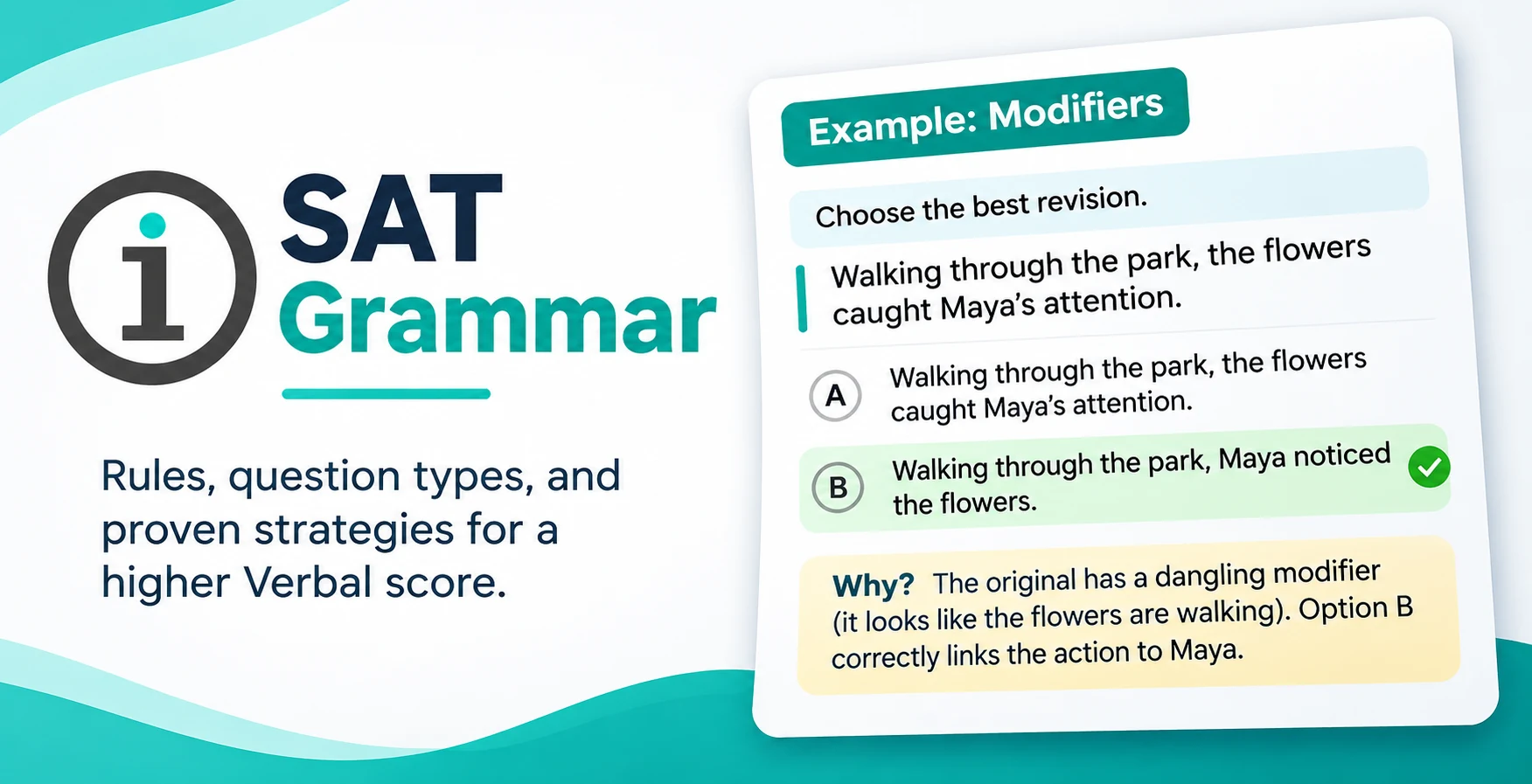
Answer choices are usually long and structurally different, almost as though it is a reading question. That is the tell. Read the modifier and ask whether it describes a person, an idea, or a thing. Then read only the subject from each answer choice and pick the answer.
Most answer choices sound grammatically acceptable and mean roughly the same thing. Do not read the entire answer choices. You will often end up choosing the one you read the most times.
SAT grammar rules: Boundaries
6. Independent clauses
Clauses have a subject and a main verb, not just any verb. Learn the formulas and apply them. All three of these boundaries are grammatically equivalent: IC ; IC / IC . IC / IC , FANBOYS IC. FANBOYS stands for for, and, nor, but, or, yet, so.
IC , for example ; IC is often correct because many students incorrectly think you cannot end a sentence with ‘for example.’ You can.
7. Dependent clauses
Learn these patterns: DC , IC / IC , DC. IC means independent clause. DC means dependent clause.
Identify the clauses first, then apply the formula.
8. Non-essential elements
Use matching punctuation: , NE , / — NE — / ( NE ). These elements can also appear at the beginning or end of a sentence: NE , IC / IC , NE. NE means non-essential element.
NE , IC can look similar to DC , IC, but a dependent clause has a main verb. ‘Which…’ creates a non-essential clause.
9. Essential elements
Essential elements have no punctuation. If you are certain an element is essential, do not hesitate to pick the option with no punctuation.
‘That…’ creates an essential clause.
10. Simple and complex lists
Simple list: x , y , and z. Complex list: a , x ; b , y ; and c , z.
Seeing ‘; and’ together in either the passage or the answer choices is a major tell that the question is testing complex lists.
11. Wrong use of commas
Subject , main verb → Do not separate. x of , y → Do not disconnect what a preposition is connecting. x and y → Do not separate two simple elements with a comma.
Check what the comma would disconnect before choosing it.
12. Question marks
Subject followed by verb is usually a statement. Verb followed by subject is usually a question. Questions often begin with how, where, why, or what.
On SAT questions, checking the order of the subject and verb is often the fastest way to identify whether a question mark is needed.
13. Colons
IC : … / Setup : Payoff. The setup before the colon must be an independent clause.
Do both checks: grammatical and logical. Does the setup form an independent clause? Does what follows deliver the payoff?
14. Titles and names
A title appearing before a name is essential. Do not place punctuation between them.
Marine Biologist Dr. Albert Johnson
Where can you download the SAT grammar rules PDF?
Download the grammar-only revision guide and use it while reviewing your practice. It covers the same rules taught on this page, with the formulas kept together for quick revision. Transitions and rhetorical synthesis are separate skills and are outside this grammar guide.
Want an SAT grammar practice PDF with answers?
Download the SAT Grammar Practice PDF with Answers. Attempt the questions first, then check the explanations at the end.
How should you approach SAT grammar practice?
Practice one rule at a time until you can recognize it in an unfamiliar sentence. Then mix the question types. Getting an answer right because it sounds familiar tells you very little. Being able to name the subject, identify the clause boundary, or explain why an element is essential tells you that you can solve the next version too.
After each set, write down the rule behind every error. Reattempt those questions without looking at the answers. Then try fresh questions testing the same rule. You can continue your practice on MyCollegeBook and use the SAT practice tests to check whether your accuracy holds when grammar is mixed with the rest of Reading and Writing.
Do you need SAT grammar by Erica Meltzer?
Erica Meltzer’s SAT grammar books are very popular. My opinion is simple: they are unnecessary. Learn the rules on this page and practice applying them to SAT questions. That is the work that raises your grammar accuracy.
If you already own the book, use it to work on a rule you keep missing. You do not need to finish another grammar book before you start answering questions. Spend your preparation time recognizing how the SAT tests each rule and fixing the mistakes you actually make.
Can you apply the rules to these SAT grammar questions?
Try the questions below before opening the answers. For each one, name the rule that decides it. The explanations show the part of the sentence you should check, so you can compare your method with the one I teach.
Practice question 1: Essential names
The Organisation for Economic Co-operation and Development (OECD) tracks comparative price list data for its thirty-eight member countries. According to this data, in July 2021, a “basket” of goods and services priced at 100 US dollars (USD) in the United States would have cost 55 USD in fellow OECD member ______
Which choice completes the text so that it conforms to the conventions of Standard English?
- nation: Costa Rica.
- nation — Costa Rica.
- nation Costa Rica.
- nation, Costa Rica.
Show answer and explanation
Answer: C.
Costa Rica identifies the fellow OECD member nation. Keep the identifying name attached to nation, with no colon, dash, or comma.
Practice question 2: Non-essential clauses
Many experts, like lawyer and cycling advocate Ernesto Hernandez-Lopez, have proposed bike travel as one possible way to alleviate congestion on the busy roadways of Los Angeles County, California. Indeed, local bicycle paths like the El Dorado Park bicycle ______ have become an increasingly popular means of travel for commuter and recreational trips alike.
Which choice completes the text so that it conforms to the conventions of Standard English?
- path, which is 4 miles long
- path which is 4 miles long —
- path, which is 4 miles long,
- path: which is 4 miles long,
Show answer and explanation
Answer: C.
The added description ‘which is 4 miles long’ needs a comma at both ends. Remove it and the sentence still reads ‘local bicycle paths like the El Dorado Park bicycle path have become…’ A supplies only the opening comma, B mixes punctuation, and D inserts an invalid colon.
Practice question 3: Titles and names
In Los Angeles County, California, bicycle paths such as the Legg Lake bicycle path—which is 2.2 miles long—have become an increasingly popular means of travel. Moreover, lawyer and cycling ______ has identified several features of the Los Angeles landscape, like its temperate climate and mostly flat roads, that make the city naturally bike-friendly.
Which choice completes the text so that it conforms to the conventions of Standard English?
- advocate, Ernesto Hernandez-Lopez,
- advocate Ernesto Hernandez-Lopez,
- advocate, Ernesto Hernandez-Lopez
- advocate Ernesto Hernandez-Lopez
Show answer and explanation
Answer: D.
The identifying description ‘lawyer and cycling advocate’ leads directly into Ernesto Hernandez-Lopez. No comma belongs between the description and name, and no lone comma belongs between the full subject and has identified.
Practice question 4: Independent-clause boundaries
Sociologist Alton Okinaka sits on the review board tasked with adding new sites to the Hawaii Register of Historic Places, which includes Grove Farm, established in 1864, and the Kauai Belt Road, a section of Route 560 along the north coast. Okinaka doesn’t make such decisions single-handedly, ____ historical designations must be approved by a group of nine other experts.
Which choice completes the text so that it conforms to the conventions of Standard English?
- however. All
- however all
- however, all
- however and all
Show answer and explanation
Answer: A.
‘Okinaka doesn’t make such decisions single-handedly, however’ is one complete sentence. ‘All historical designations must be approved by a group of nine other experts’ is another. However belongs at the end of the first sentence here; the period supplies the boundary.
Practice question 5: Subject-verb agreement
Florence Este and Lily Everett were among the 300 artists who exhibited at the 1913 Armory Show, a groundbreaking New York City art exhibition that introduced modernism to American audiences. Though shocking at the time, an abstract cubist painting exhibited by Marcel Duchamp — one of several works that received scorn from critics— ____ the Western art canon more than a century later.
Which choice completes the text so that it conforms to the conventions of Standard English?
- were entering
- enter
- has entered
- have entered
Show answer and explanation
Answer: C.
The subject is the singular noun painting. The plural words works and critics sit inside the non-essential description and do not control the verb. Has entered supplies the singular finite verb the clause needs.
What grammar is on the SAT?
Standard English Conventions covers two groups: Form, Structure, and Sense, and Boundaries. Learn verb forms, subject-verb agreement, pronoun agreement, possessives, and modifier placement in the first group. Learn clauses, sentence boundaries, punctuation, essential information, and non-essential information in the second. These are the rules in the revision guide above.
Is SAT grammar hard?
SAT grammar becomes straightforward once you can identify the structure a question is testing. Long passages make simple rules look complicated. Find the subject and main verb, separate the clauses, and use the formulas. That is how I teach students to stop relying on how an answer sounds.
How can you improve SAT grammar quickly?
Start with the two video lessons, keep the cheat sheet beside you, and attempt the questions without opening the explanations. For every mistake, write the rule you missed and practice another question on that rule. Spend your time fixing repeat errors before taking another full test.
Are transitions part of SAT grammar?
Transitions and rhetorical synthesis are tested under Expression of Ideas. They are separate from Standard English Conventions. This page and the grammar-only PDF cover grammar and punctuation. The full SAT syllabus shows how those skills fit into Reading and Writing.
What should you do after this SAT grammar practice?
Review every wrong answer against the rules above, then practice that question type again. Grammar becomes faster when you recognize the structure immediately. Keep the PDF for revision and return to mixed sets once the individual rules are familiar.
For the rest of your preparation, use our SAT prep resources. The same recognition-first approach is explained in how to improve your SAT Math score. You can also read what our students and parents say about their preparation.
Book Your Free SAT Trial Class
Start your journey to a 1500+ SAT Score.